AWS Nitro Isolation Engine explained: the formally verified hypervisor on Graviton5
The Nitro Isolation Engine is AWS's formally verified isolation layer on Graviton5 EC2. What it proves, what it doesn't, instances, cost and FAQs.
The AWS Nitro Isolation Engine is a small piece of Amazon EC2's virtualization layer, written in Rust, that decides whether anything may touch a customer virtual machine's memory and state. AWS has used mathematical proof to show it keeps VMs apart. It's switched on automatically for Graviton5-based EC2 instances, and there is nothing to configure. AWS calls the result "the first formally verified hypervisor deployed in a commercial cloud environment."
AWS first presented the engine at re:Invent 2025 and published its white paper and a technical blog in June 2026. On 25 November 2026, Amazon published a plain-English explainer on aboutamazon.com, and search interest has picked up since. So this isn't a new launch. Here is what it is, what the proof covers and what it doesn't, and whether it should change which instances you pick.
What is the AWS Nitro System?
Nitro is the custom hardware and software under every modern EC2 instance. EC2 originally ran on the Xen hypervisor, which handled networking, storage, security groups and CPU scheduling on the same processors customers paid for. Starting in 2013, AWS moved those jobs onto dedicated cards built with Annapurna Labs, the chip startup Amazon bought in 2015. Networking moved first, then EBS and local storage, and last came a stripped-down hypervisor with no networking, no storage stack and no remote login.
AWS launched Nitro in 2017. Amazon's key claims, from its 25 November article and the Nitro Isolation Engine white paper:
- There is "no mechanism for any system or person to sign in to EC2 Nitro hosts, read instance memory, or access customer data" on encrypted instance storage or EBS volumes.
- Independent firm NCC Group reviewed the design in 2023 and "found no mechanism for a cloud operator to access customer data."
- AWS has written these no-operator-access controls into its AWS Service Terms.
- Nitro Cards are in their sixth generation. The latest ones encrypt traffic between supported instances automatically. Graviton servers have always-on memory encryption, starting with Graviton2.
If you're comparing this with AWS's newer sandbox products, our Nitro Sandboxes explainer covers a different feature that runs on the same Nitro base.
What is the Nitro Isolation Engine?
The Nitro Hypervisor has kept customer VMs apart since 2017, but it also does many other jobs, which makes it very hard to prove correct as a whole. So AWS split the work in two:
- The Nitro Hypervisor keeps the "policy" jobs: creating VMs, allocating resources, migration and scheduling. It is now deprivileged. It can no longer directly touch guest memory or state.
- The Nitro Isolation Engine is a small "separation kernel" that does the "mechanism" work. Any operation that touches a VM's state has to go through the engine as a request, and the engine checks each request before acting on it.
The engine is written in a restricted subset of Rust, and AWS built it from the start to be verified. According to the white paper, it controls access to VM memory, I/O devices and the interrupt controller. AWS says it designed Graviton5's interrupt controller (GIC) with this isolation in mind.
What did AWS actually prove?
"Formally verified" means engineers wrote a precise mathematical specification of what the code should do, then used a proof assistant to check that the code meets it for every possible input, not only the inputs a test happens to try. AWS used Isabelle/HOL. The Amazon Science blog from June 2026 says the model and proofs come to "330,000 lines of machine-checked mathematics," which it calls "comparable in scale to seL4." seL4 is the best-known formally verified microkernel.
The white paper lists four proven properties:
- Confidentiality and integrity. Nothing unauthorized can read or write a guest VM's private data.
- Functional correctness. The code behaves exactly as specified, "with no additional behaviors."
- Absence of runtime errors. No panics, arithmetic overflows or unwraps of empty values.
- Memory safety. No buffer overflows, null-pointer dereferences or out-of-bounds accesses. This applies to both safe and
unsafeRust.
What does the proof NOT cover?
AWS itself calls this a "living document" and lists the gaps. This checklist is drawn from the white paper. It's the part most coverage leaves out:
| Area | Covered by the proof? | What AWS says |
|---|---|---|
| VM creation and configuration | Yes | One of the first three parts of the VM lifecycle covered |
| vCPU management | Yes | Covered |
| Memory management | Yes | Covered |
| Other parts of the VM lifecycle | Not yet | AWS says it plans to expand the proof scope |
| Side-channel attacks (Spectre-style, caches, speculation) | No | Handled by design instead: "secret-hiding," speculation barriers, and not sharing L1 caches between guest VMs |
| Bootloaders, firmware, Graviton5 hardware | Assumed correct | The proofs assume more privileged code and the hardware behave as specified |
| Rust compiler and proof tools | Trusted | Treated as trusted parts of the proof stack |
| Concurrency across CPUs | Partly | Shared data uses a strict two-phase locking discipline. The locking primitives were proven separately in the Iris and Verus tools |
| Rest of Nitro (cards, control plane) | No | Covered by testing, design reviews and independent audits, per Amazon |
Put simply, the proof is strong evidence that the isolation code does what it should. It doesn't prove that a whole EC2 server can't be attacked.
Which EC2 instances use the Nitro Isolation Engine?
Only Graviton5-based instances. The Amazon Science blog names the M9g and M9gd families as the first to use it, and Amazon's 25 November article says it is "always on for Graviton5-based instances." That puts the general-purpose, compute and memory families on Graviton5 in scope. See our guides to Graviton5 instances and pricing and the burstable T9g. Older Graviton generations and Intel and AMD instances still run on the Nitro Hypervisor with Nitro's design protections. They don't have this formally verified engine.
How much does it cost, and do I need to turn it on?
There is nothing to turn on. Amazon describes it as always on for Graviton5, and AWS doesn't list it as a separately priced feature. You pay the normal price for the Graviton5 instance.
Is the Nitro Isolation Engine open source?
Not the engine itself, as far as we could confirm. Amazon's 25 November article says AWS "open-sourced the proof tooling it built." The Amazon Science blog specifies that the general-purpose proof infrastructure, called AutoCorrode (including the µRust formalization, specification language and proof automation), was open-sourced in 2025 at github.com/awslabs/AutoCorrode. We found no official source saying the engine's code or its full proofs are public.
Does it matter for compliance and regulated workloads?
Amazon is pitching the engine at banks, hospitals and governments that must show auditors how tenant isolation works. The white paper is written for that audience. Two practical points:
- It's evidence, not a certification. The white paper says customers "are responsible for making their own independent assessment." A proof isn't a compliance attestation such as SOC 2 or a FedRAMP authorization.
- It may make Graviton5 easier to justify. If your risk team worries about multi-tenant isolation, "the isolation layer on this instance family is formally verified" is a concrete, documented claim you can point to, alongside NCC Group's 2023 review.
What are people saying?
The reaction we could find is thin. A Hacker News submission of the re:Invent 2025 talk, posted 14 December 2025, drew no comments. We found no substantial Reddit threads to cite, so we aren't quoting anyone. The questions people are searching for are "what is the Nitro Isolation Engine," "Nitro Isolation Engine whitepaper," "AWS Nitro hypervisor," and "AWS Nitro instance types." This article answers each of them.
Editor's take
This matters more than its low profile suggests. Hyperscalers usually ask customers to trust their isolation. AWS has published a white paper that sets out exactly what is proven and what is assumed, including that side channels are out of scope and that hardware and firmware are trusted. That's unusually open, and the "what's not covered" section is where the value lies for anyone evaluating it. The limits are real, though: the engine exists only on Graviton5, the proof covers three parts of the VM lifecycle so far, and AWS hasn't published the engine itself. For most teams it doesn't change much day to day. For teams already moving to Graviton5 for price and performance, it's a security bonus that costs nothing extra.
FAQ
What is the Nitro Isolation Engine?
A small, formally verified Rust component inside the AWS Nitro System that controls all access to a virtual machine's memory and state on Graviton5-based EC2 instances. It keeps customer VMs isolated from each other.
Is the AWS Nitro hypervisor formally verified?
The isolation part is. AWS moved isolation into the Nitro Isolation Engine and proved it in Isabelle/HOL. The rest of the Nitro Hypervisor, which handles scheduling, VM creation policy and migration, isn't covered by the proof.
Where is the Nitro Isolation Engine whitepaper?
AWS published it in June 2026. It's linked in our Sources section below and covers architecture, proven properties, assumptions and known gaps.
Which instance types support the Nitro Isolation Engine?
Graviton5-based EC2 instances, starting with M9g and M9gd. Amazon says it is always on for Graviton5.
Can AWS employees access my EC2 data?
Amazon says the Nitro System has "no mechanism for any system or person to sign in to EC2 Nitro hosts" or read instance memory, that NCC Group's 2023 review found no such mechanism, and that these commitments are in the AWS Service Terms.
Does the Nitro Isolation Engine protect against Spectre-style side-channel attacks?
The proofs don't cover micro-architectural side channels. AWS says it handles those through design measures such as secret-hiding, speculation barriers and not sharing L1 caches between guest VMs.
What is a Nitro Card?
A dedicated AWS-designed card in each EC2 server that handles networking, storage and security work, taking those jobs off the main CPU. AWS says Nitro Cards are now in their sixth generation.
Is the Nitro Isolation Engine open source?
AWS has open-sourced the AutoCorrode proof tooling. We couldn't confirm that the engine's source code or full proofs are public.
Sources
- Amazon: How the AWS Nitro System protects customers' most sensitive data (25 November 2026)
- AWS: Nitro Isolation Engine whitepaper (June 2026)
- Amazon Science: EC2's formally verified "isolation engine" provides mathematical assurance of virtual-machine isolation (10 June 2026)
- Hacker News: AWS re:Invent 2025 – Introducing Nitro Isolation Engine
More from 9to5Amazon today: How many Amazon Leo satellites are in orbit? Launch tracker.
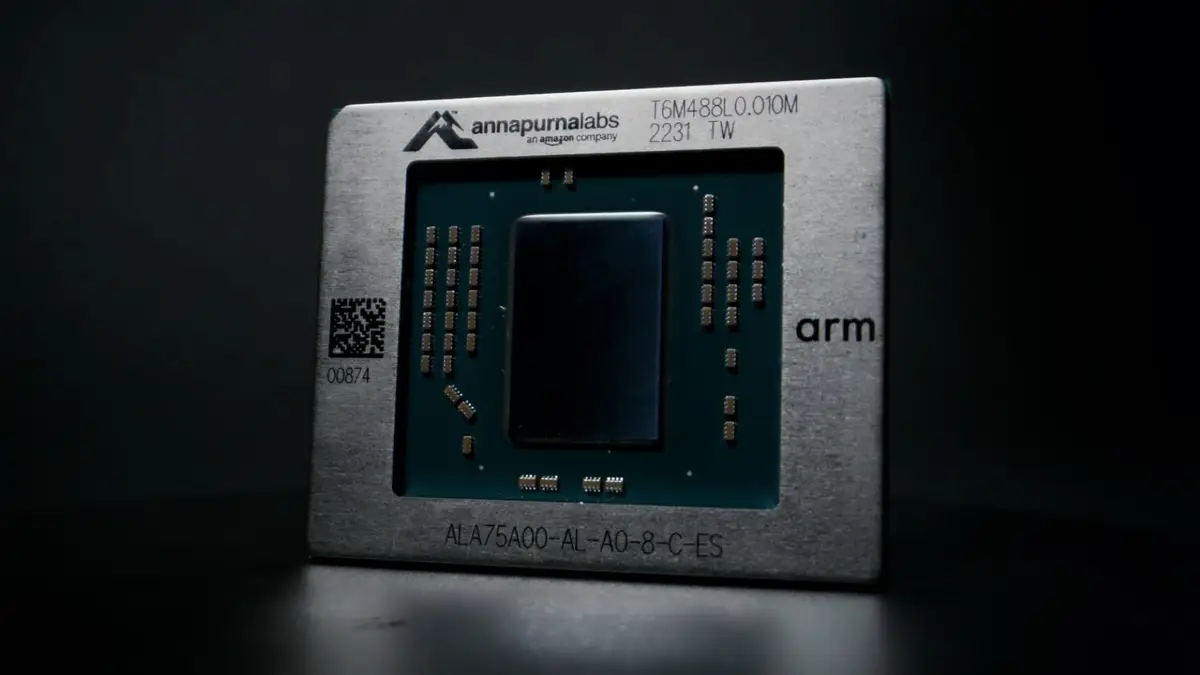
Featured image: An Annapurna Labs custom Arm-based chip, as pictured by Amazon in its Nitro System article. It shows Amazon custom silicon, not specifically a Nitro Card or a Graviton5 processor. Photo: Amazon. Source