Amazon Leo LE-04: Ariane 6 Launch Time, How to Watch and Why These 36 Satellites Matter
Amazon Leo's 36-satellite LE-04 launches on Ariane 6 at 11:09 UTC on 23 Nov 2026. Time in your zone, live stream, timeline and what's at stake.
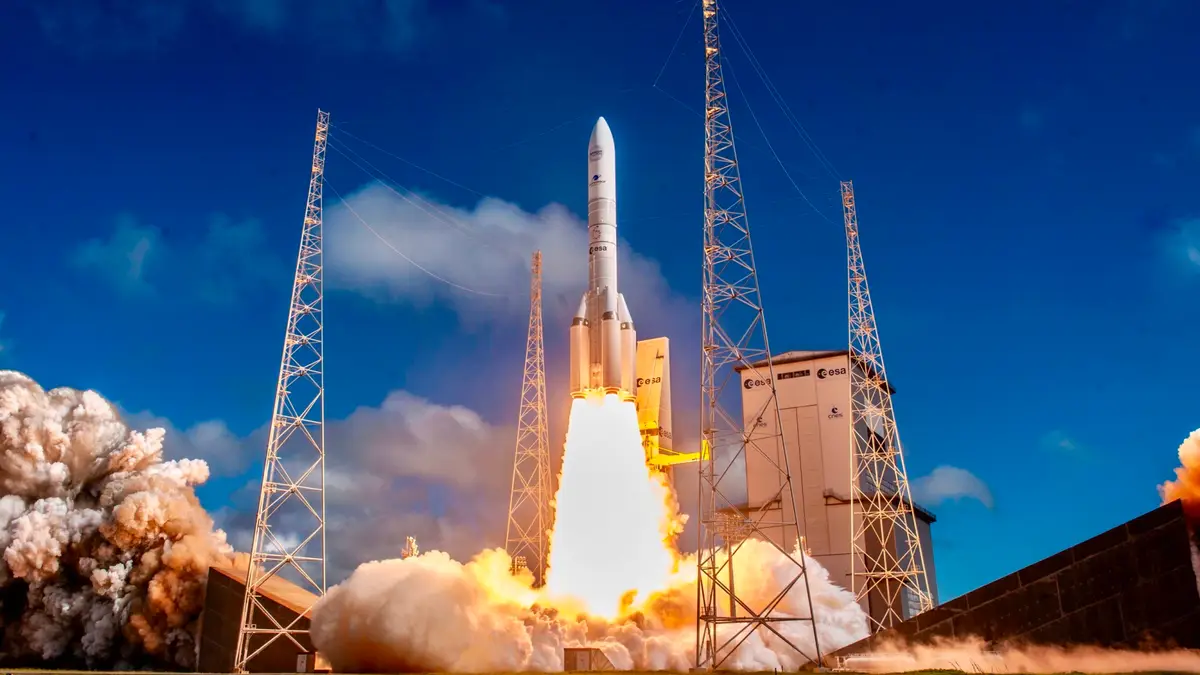
Amazon's next batch of 36 Amazon Leo internet satellites is scheduled to launch on an Ariane 6 rocket on Monday, 23 November 2026, at 11:09 UTC (6:09 a.m. ET, 8:09 a.m. local time in French Guiana). The launch window is 29 minutes long, and you can watch it free on Arianespace's webcast. It's Amazon's first launch since a ULA Vulcan rocket failed on 15 November and destroyed 40 Leo satellites, so this one matters more than usual.
Below: the launch time in your time zone, how to watch, what happens minute by minute, and what success or a delay would mean for Amazon's Starlink rival.
This article was written before liftoff. Launch times often slip, so check Amazon's and Arianespace's official channels on the day.
Update (27 November 2026): LE-04 launched successfully on 24 November
The launch slipped one day. Arianespace postponed it "following the technical event that occurred on November 23 affecting the launcher's ground support systems." Ariane 6 (flight VA271) then lifted off from Kourou at 11:14 UTC on Tuesday 24 November 2026, according to Amazon's mission page. ArianeGroup says all 36 satellites had separated 2 hours and 4 minutes after liftoff. Amazon says the release altitude was about 465 km and that its Redmond operations team has taken control. Amazon now says it has "more than 400 satellites deployed". By our count of its mission log, the total is 432. See our Amazon Leo satellite tracker for the full running total. The pre-launch article follows.
What time is the Amazon Leo Ariane 6 launch?
Amazon's mission page lists 6:09 a.m. EST (11:09 UTC) on Monday, 23 November 2026. Space.com reports the window is 29 minutes long, which means the rocket can lift off any time up to about 11:38 UTC.
| Location | Window opens | Day |
|---|---|---|
| UTC / London (GMT) | 11:09 | Mon 23 Nov |
| Kourou, French Guiana | 08:09 | Mon 23 Nov |
| New York (ET) | 06:09 | Mon 23 Nov |
| Seattle / Los Angeles (PT) | 03:09 | Mon 23 Nov |
| Paris / Berlin (CET) | 12:09 | Mon 23 Nov |
| New Delhi (IST) | 16:39 | Mon 23 Nov |
| Tokyo (JST) | 20:09 | Mon 23 Nov |
| Sydney (AEDT) | 22:09 | Mon 23 Nov |
Time zone conversions are ours, from the official 11:09 UTC time.
How can I watch the Amazon Leo launch live?
- Arianespace webcast. Arianespace streams every Ariane 6 launch on its website and YouTube channel. Space.com says coverage starts about 30 minutes before liftoff, so tune in around 10:40 UTC.
- Space.com. It plans to carry the Arianespace feed on its launch page.
- Amazon's mission page. Amazon updates its Leo mission tracker on aboutamazon.com with status notes, though not always in real time.
You don't need an account or subscription for any of these.
What is the LE-04 mission?
LE-04 ("Leo Europe 04") is Amazon's name for this flight; Arianespace calls it VA271. The key facts, from Arianespace and Amazon:
| Detail | LE-04 |
|---|---|
| Rocket | Ariane 64 (Ariane 6 with four solid boosters) |
| Launch site | Europe's Spaceport (Guiana Space Centre), Kourou, French Guiana |
| Payload | 36 Amazon Leo satellites |
| Release altitude | About 465 km (289 miles), per Amazon |
| Final altitude | About 630 km (392 miles), raised by the satellites themselves |
| Liftoff to last deployment | About 2 hours 4 minutes, per Arianespace |
| Ariane 6 flight number | 10th Ariane 6 flight, 4th for Amazon |
| Arianespace launch total | 363rd Arianespace launch, its 5th of 2026 |
After the satellites separate, Amazon's mission operations center in Redmond, Washington takes over, checks each spacecraft, and raises them to their working orbit before they're commissioned for service.
What happens during the launch? (timeline)
Here's a simple view of the morning, built from the official times. Anything after liftoff is approximate.
| Time (UTC) | What to expect |
|---|---|
| ~10:40 | Webcast starts (per Space.com) |
| 11:09 | Window opens; liftoff if all is go |
| 11:38 | Window closes; if it hasn't launched, it's a scrub for the day |
| ~13:13 | Final satellite deployment, about 2 h 4 min after an on-time liftoff (Arianespace's mission length) |
| Later that day or next | Amazon usually confirms contact with the satellites on its mission page |
The long gap between liftoff and final deployment is normal for these flights: the upper stage releases the satellites in groups over roughly two hours.
Why does this launch matter after the Vulcan failure?
On 15 November 2026, ULA's Vulcan rocket failed about 10 minutes into its first Amazon flight (LV-01), and all 40 satellites were lost. We covered it in detail in our Vulcan failure explainer. Space.com reports ULA traced the problem to an "inadequate fuel supply" to the first-stage engines, and Vulcan is grounded while ULA investigates.
That leaves Ariane 6 as the rocket carrying Amazon's next batch, for three reasons:
- It's a completely different rocket. Ariane 6 shares no engines or stages with Vulcan, so the Vulcan investigation doesn't directly affect it.
- Its record with Amazon is clean so far. All three earlier Ariane 6 flights for Amazon delivered their satellites (see the table below). Space.com notes Ariane 6's only problem in nine flights was a partial failure on its July 2024 debut, which didn't carry Amazon satellites.
- Other options are limited right now. Space.com reports Blue Origin's New Glenn, which Amazon has also booked, hasn't flown since April and was damaged in a pre-launch test explosion on 28 May.
Amazon Leo flights on Ariane 6 so far
| Mission | Date | Satellites | Result |
|---|---|---|---|
| LE-01 (VA267) | February 2026 | 32 | Deployed |
| LE-02 (VA268) | 30 April 2026 | 32 | Deployed at about 465 km, per Arianespace |
| LE-03 (VA269) | 17 June 2026 | 36 | Deployed; Space.com called it the heaviest Ariane payload ever |
| LE-04 (VA271) | 23 November 2026 (planned) | 36 | Scheduled |
If LE-04 succeeds, Arianespace says it will have deployed 136 Amazon Leo satellites in total.
How many Amazon Leo satellites are in orbit?
Amazon says it has launched "nearly 400 satellites" across 14 successful missions, which it describes as making Leo the third-largest constellation in orbit. That count doesn't include the 40 lost on Vulcan. A successful LE-04 would push the total past 430.
For scale, the full first-generation network is planned at more than 3,200 satellites, and Space.com says SpaceX's Starlink has more than 11,000 operational spacecraft. Amazon has a long way to go.
When will Amazon Leo internet service start?
Amazon hasn't given a public date. Its mission page says only that Leo is "preparing to roll out service to customers worldwide." It has announced business partners, including an operator in Uzbekistan and South African provider Herotel, but no consumer launch date or price. Our Amazon Leo launch date, price and speeds guide tracks what Amazon has confirmed, and our beginner's explainer covers how the system works.
One deadline is fixed. As we reported after the Vulcan loss, the FCC waived Amazon's July 2026 half-constellation milestone with conditions, but the deadline to deploy the full first-generation constellation, 30 July 2029, hasn't changed. Every successful batch of 36 helps.
What are people asking about the launch?
We looked for community discussion of LE-04 on Reddit and space forums before publishing and didn't find substantial threads we could quote, so we're not quoting anyone. These are the questions people are searching for, based on Google's autocomplete:
- Is the Ariane 6 launch happening today, and what time?
- Is Ariane 6 safe for Amazon after Vulcan failed?
- How many Amazon Leo satellites are in orbit?
- When can I actually buy Amazon Leo internet?
We answer each one in this article and the FAQ below.
What if the launch is delayed?
Delays are common and usually aren't a sign of trouble. Weather in Kourou, a ground-system issue, or a last-minute check can push the launch to a later day. Arianespace and Amazon will announce a new date if that happens. Our Vulcan launch-day guide shows how that mission slipped twice for ground issues before it flew.
Editor's take
This is a routine-looking launch with outsized stakes. Ariane 6 has done this job three times for Amazon without a hitch, and nothing about the Vulcan failure touches this rocket. But Amazon has just lost about a tenth of everything it has ever launched, Vulcan is grounded, and New Glenn isn't flying, so for now Europe's rocket (and SpaceX's Falcon 9) are carrying Amazon's plans. A clean LE-04 doesn't fix Amazon's launch-capacity problem, but a second setback in eight days would make the 2029 deadline and any 2026 service start look much harder. If you're waiting for Amazon Leo at home, the honest answer is that one launch won't change your timeline much. Watch how quickly Vulcan returns to flight instead.
FAQ
What time is the Ariane 6 launch today?
The window opens at 11:09 UTC on Monday, 23 November 2026 (6:09 a.m. ET, 3:09 a.m. PT, 12:09 CET) and lasts 29 minutes.
Where can I watch the Amazon Leo launch live?
On Arianespace's free webcast (website and YouTube), which Space.com is also carrying. Coverage starts about 30 minutes before liftoff.
How many satellites is Ariane 6 launching for Amazon?
36 Amazon Leo satellites on mission LE-04 (Arianespace flight VA271).
Is Ariane 6 affected by the Vulcan failure?
Not directly. Ariane 6 is a different rocket with different engines. ULA's preliminary finding on Vulcan pointed to the fuel supply to its first-stage engines.
How many Amazon Leo satellites are in orbit now?
Amazon says "nearly 400" have been launched across 14 successful missions. The 40 satellites on Vulcan were lost and aren't counted.
Where does Ariane 6 launch from?
Europe's Spaceport (Guiana Space Centre) in Kourou, French Guiana, on the northeast coast of South America.
When will Amazon Leo internet be available?
Amazon hasn't announced a consumer date or price. It says it's preparing to roll out service worldwide.
What is the difference between Ariane 6 and Ariane 64?
Ariane 64 is the version of Ariane 6 with four solid rocket boosters, used for heavy payloads like 36 Leo satellites. Ariane 62 has two boosters.
Sources
- Amazon, Amazon Leo mission updates: https://www.aboutamazon.com/news/innovation-at-amazon/project-kuiper-satellite-rocket-launch-progress-updates
- ArianeGroup, "Arianespace to launch 36 Amazon Leo satellites on November 23 at the earliest": https://www.ariane.group/en/news/arianespace-to-launch-36-amazon-leo-satellites-on-november-23-at-the-earliest-for-10th-ariane-6-flight/
- Arianespace, LE-02 launch release (30 April 2026): https://newsroom.arianespace.com/?p=49232
- Space.com, "Watch live on Nov. 23: Amazon launching 1st batch of internet satellites since Vulcan Centaur failure": https://www.space.com/space-exploration/launches-spacecraft/arianespace-ariane-6-amazon-leo-internet-satellite-launch
- Space.com, LE-03 record-breaking launch: https://www.space.com/space-exploration/launches-spacecraft/ariane-6-rocket-record-breaking-launch-amazon-leo-le-03
Planning to watch a different Amazon event this week? See our AWS re:Invent 2026 keynote schedule.
Featured image: Amazon. An Ariane 64 lifting off on an earlier Amazon Leo mission (LE-01), not the LE-04 rocket. Source