Amazon Leo Vulcan LV-01 Launch: Time, How to Watch and Why This Flight Matters
Amazon Leo's LV-01 Vulcan launch targets Nov 13, 2026 at 12:54 p.m. EST with 40 satellites. Global launch times, livestream, and Vulcan's return to flight.
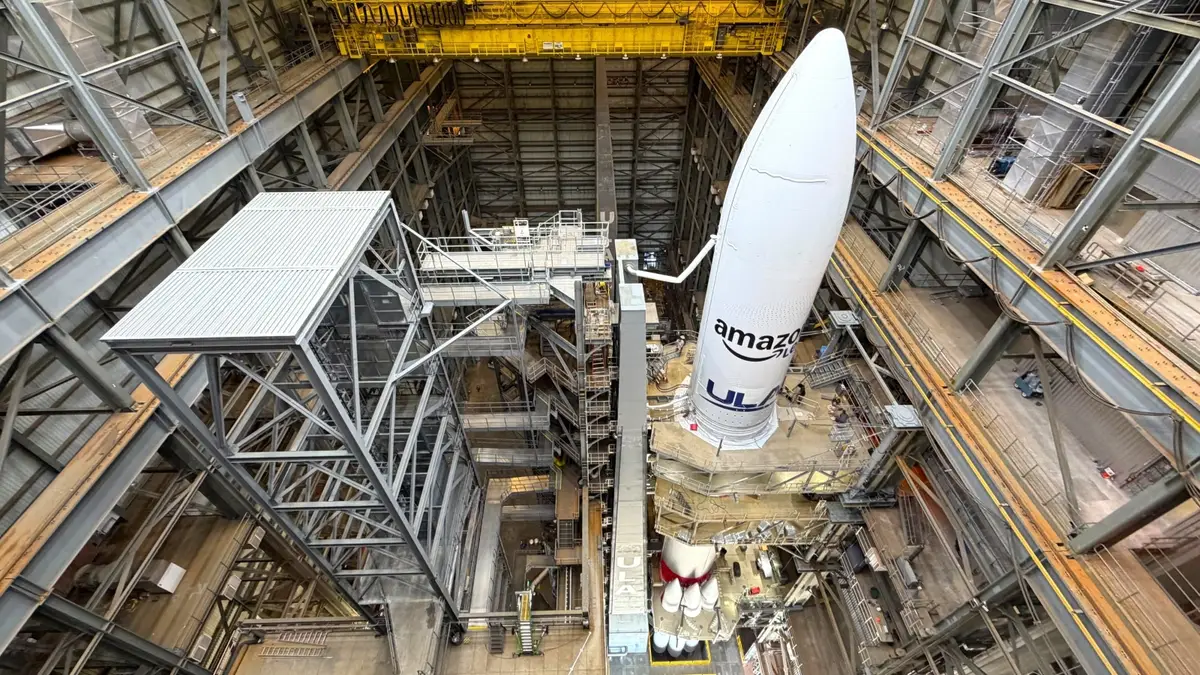
Amazon Leo's first launch on ULA's Vulcan rocket, called LV-01, is scheduled for Friday, November 13, 2026 at 12:54 p.m. EST (17:54 UTC) from Cape Canaveral, Florida. It will carry 40 Amazon Leo internet satellites, the most Amazon has put on a single rocket so far. It's also Vulcan's first flight since a booster problem in February grounded it for about nine months. Amazon says the date is "pending range approval," so it can still slip.
Here's the launch time in your time zone, how to watch, why this flight matters more than most Leo launches, and what it means for Amazon's plan to start service before the end of 2026.
When is the Amazon Leo Vulcan launch?
| Detail | What Amazon and ULA say |
|---|---|
| Mission | LV-01 ("Leo Vulcan 1") |
| Date | Friday, November 13, 2026 (pending range approval) |
| Liftoff time | 12:54 p.m. EST / 17:54 UTC |
| Launch site | Space Launch Complex-41 (SLC-41), Cape Canaveral Space Force Station, Florida |
| Rocket | ULA Vulcan VC6L: six GEM 63XL solid rocket boosters, long 70-ft payload fairing, LEO-optimized Centaur V upper stage |
| Payload | 40 Amazon Leo satellites |
| Contract | First of 38 Vulcan launches Amazon has booked with ULA |
Neither Amazon nor ULA had published the length of the launch window on their pages when we checked. Some launch trackers list a window of about 30 minutes, but we couldn't confirm that from an official source.
LV-01 launch time around the world
| City | Local time |
|---|---|
| Los Angeles (PST) | Fri Nov 13, 9:54 a.m. |
| New York / Cape Canaveral (EST) | Fri Nov 13, 12:54 p.m. |
| London (GMT) | Fri Nov 13, 5:54 p.m. |
| Berlin / Paris (CET) | Fri Nov 13, 6:54 p.m. |
| Dubai (GST) | Fri Nov 13, 9:54 p.m. |
| New Delhi (IST) | Fri Nov 13, 11:24 p.m. |
| Tokyo (JST) | Sat Nov 14, 2:54 a.m. |
| Sydney (AEDT) | Sat Nov 14, 4:54 a.m. |
Conversions are our own from the official 17:54 UTC time. If the launch is delayed, every time above moves with it.
How to watch the Amazon Leo LV-01 launch
- ULA's mission page (ulalaunch.com, "Vulcan Leo 1") has a launch livestream section. ULA hadn't posted a webcast start time when we checked.
- Amazon's Leo mission updates page on aboutamazon.com is where Amazon posts date changes and post-launch confirmations, such as whether the satellites have made contact.
- In person: SLC-41 launches are visible from Florida's Space Coast. If you're travelling, check the date on the day, because a scrub can push it back by a day or more.
Why does this launch matter? Vulcan's return to flight
This is the fifth Vulcan flight, and its first since February 12, 2026. On that flight (USSF-87, a Space Force mission), one of Vulcan's Northrop Grumman GEM 63XL solid rocket boosters malfunctioned. The rocket still reached orbit because the core stage made up the difference. It was the second booster nozzle problem in four Vulcan flights, after a nozzle came off a booster on Vulcan's second test flight in October 2024. Wikipedia's Vulcan launch list says the February anomaly led the US Space Force to pause national security launches on Vulcan until the booster issues are resolved.
According to Broadband Breakfast, ULA says the November 13 mission will fly with an improved nozzle design. Vulcan "spent months grounded" before this return.
LV-01 also brings several firsts, according to Amazon:
- First Vulcan with six boosters (the "6" in VC6L). Earlier flights used two or four.
- First flight of a shorter, LEO-optimized Centaur V upper stage
- First rocket prepared in VIF-A, a new Vertical Integration Facility at Cape Canaveral that Amazon paid for, along with a new mobile launch platform. Amazon says this lets ULA prepare two Vulcans at the same time. LV-02 is being stacked in ULA's other building (VIF-G) and is "expected to launch within weeks of a nominal LV-01 mission."
New rocket configuration, a fix after a booster problem and a new launch facility, all on one flight: that's a lot of first-time risk. That's our reading. Amazon and ULA haven't put it that way.
Vulcan flight history at a glance
| # | Date (UTC) | Config | Mission | Result |
|---|---|---|---|---|
| 1 | Jan 8, 2024 | VC2S | Peregrine lunar lander | Rocket succeeded (lander later failed for unrelated reasons) |
| 2 | Oct 4, 2024 | VC2S | Cert-2 test flight | Success despite booster nozzle anomaly |
| 3 | Aug 13, 2025 | VC4S | USSF-106 | Success |
| 4 | Feb 12, 2026 | VC4S | USSF-87 | Success despite second booster malfunction |
| 5 | Nov 13, 2026 (target) | VC6L | Amazon Leo LV-01 | — |
Source: Wikipedia's List of Vulcan launches; LV-01 details from Amazon and ULA.
How many Amazon Leo satellites are in orbit now?
Amazon says it has launched "nearly 400 satellites to date" across 14 missions. Adding up Amazon's per-mission figures gives 396, the same number Broadband Breakfast reports. The last Leo launch was LA-08 on July 2, 2026, so this is the first Leo launch in more than four months.
| Scenario | Satellites launched (our count) |
|---|---|
| Today | 396 |
| After LV-01 (40), if successful | 436 |
| After LE-04 on Ariane 6 (36, NET Nov 23) | 472 |
Amazon plans a first-generation constellation of more than 3,000 satellites. According to Orbital Radar, Amazon missed the FCC's July 30, 2026 milestone for having half of them in orbit. The FCC granted a conditional waiver in June, and the full first-generation deadline stays July 30, 2029. We covered the deadline and service plans in our Amazon Leo launch date, price and Starlink comparison.
Why Vulcan is so important to Amazon Leo
Melissa Wuerl, Amazon Leo's director of launch systems, said in Amazon's announcement: "Vulcan will launch close to half our first-generation constellation." Amazon says Vulcan will carry more than 1,500 satellites across 38 missions, more than any other rocket in the program, and will be the "primary workhorse over the next several years."
LV-01 and the first few missions carry 40 satellites each. Amazon says it plans "larger configurations" for later missions as Vulcan's performance improves. Here's how that compares with the rockets Amazon has used so far:
| Rocket | Leo satellites per launch (so far) | Status |
|---|---|---|
| ULA Atlas V | 27–29 | 8 Leo launches flown |
| SpaceX Falcon 9 | 24 | 3 Leo launches flown |
| Arianespace Ariane 64 | 32–36 | 3 flown. LE-04 targeting NET Nov 23 |
| ULA Vulcan VC6L | 40 | LV-01 targets Nov 13. 38 booked |
| Blue Origin New Glenn | — | Listed by Amazon as a launch provider |
Per-launch numbers are from Amazon's mission tracker. Amazon says it has more than 100 missions on its manifest across Arianespace, Blue Origin, SpaceX and ULA.
Amazon also says it finished its 1,000th satellite in early September and has "hundreds of flight-ready satellites." In other words, satellites are waiting on rockets, not the other way round. That gap is why Vulcan's return matters so much.
What does LV-01 mean for Amazon Leo service?
Amazon CEO Andy Jassy told analysts on October 29 that "Amazon Leo remains on track to get initial service this year" (quoted by Broadband Breakfast). In its Vulcan announcement, Amazon repeats that initial service rollout is expected later this year, with a fast expansion after that. Amazon still hasn't published consumer prices or a sign-up date. See our Q3 2026 earnings recap for what Amazon told investors.
A successful LV-01 doesn't switch on consumer service by itself. Satellites typically need time to raise their orbits and be checked out. A failure or long delay, though, would set back the constellation's buildout, given how much of the plan rests on Vulcan.
Editor's take: For anyone on the Leo waitlist, Friday's launch is the most important one this year. A clean flight means Vulcan is back, LV-02 can follow "within weeks," and Amazon's sub-400 satellite count finally starts climbing again. Watch for three things after liftoff: whether all six boosters perform normally, whether the Centaur V deploys all 40 satellites, and whether Amazon confirms contact with them. Range approval and weather can easily push the date, and a slip of a few days wouldn't be unusual.
What are people saying?
At the time of writing, we didn't find a substantial Reddit or forum thread with reactions to the LV-01 date that we could quote. Launch threads usually appear in the days before liftoff. The questions we keep seeing in search and on launch trackers:
- What time is the Amazon Leo Vulcan launch, and will there be a livestream?
- Is Vulcan safe to fly after the booster problems?
- When can I actually buy Amazon Leo?
- How many Amazon Leo satellites are in orbit, compared with Starlink?
Amazon Leo Vulcan launch FAQ
What time is the Amazon Leo Vulcan launch?
12:54 p.m. EST (17:54 UTC) on Friday, November 13, 2026, pending range approval, per Amazon and ULA.
Where is the Amazon Leo LV-01 launch?
Space Launch Complex-41, Cape Canaveral Space Force Station, Florida.
How many satellites are on the Amazon Leo Vulcan 1 launch?
40, the largest Amazon Leo payload so far.
Where can I watch the Amazon Leo Vulcan launch live?
On ULA's mission page for Vulcan Leo 1, which has a livestream section. Amazon posts updates on its Leo mission updates page.
Why was Vulcan grounded?
A solid rocket booster malfunctioned on the February 12, 2026 flight. That was the second booster nozzle problem in four flights. ULA says LV-01 will fly with an improved nozzle design, according to Broadband Breakfast.
What is Vulcan VC6L?
Vulcan with six GEM 63XL solid rocket boosters and the long payload fairing. ULA calls it the configuration for this mission, and Amazon says LV-01 is its first flight.
When is the next Amazon Leo launch after LV-01?
LE-04 on Ariane 6 (36 satellites) is targeting no earlier than November 23 from Kourou, French Guiana. Amazon says LV-02 should follow "within weeks" of a nominal LV-01.
Is Amazon Leo available yet?
No. Amazon says initial service is expected later in 2026. Prices and a consumer launch date haven't been announced.
Also today: Amazon Haul's early Haul-iday sale: dates, 11-cent deals and the fine print.
Sources
- Amazon: Amazon Leo to launch 40 satellites on its first Vulcan mission (Nov 9, 2026)
- Amazon: Amazon Leo mission updates
- ULA: Vulcan Leo 1 mission page
- Broadband Breakfast: Amazon Leo to launch 40 more broadband satellites Nov. 13 (Nov 2, 2026)
- Wikipedia: List of Vulcan launches
- Orbital Radar: Amazon Leo targets Vulcan debut: Orbital Briefing, 9 November
- Amazon: What you need to know about Amazon today: November 9, 2026
Featured image: 40 encapsulated Amazon Leo satellites stacked atop ULA's Vulcan rocket inside VIF-A at Cape Canaveral ahead of LV-01. Photo: Amazon. Source