Kimi K3.1 Pro on Amazon Bedrock: Price vs Kimi API, Regions and License Explained
Kimi K3.1 Pro Highspeed is on Amazon Bedrock at $4/$20 per 1M tokens. Compare it with the Kimi API, see a cost example, benchmarks and license terms.
Moonshot AI's Kimi K3.1 Pro is now on Amazon Bedrock. AWS added it on November 6, 2026 as Kimi K3.1 Pro (Highspeed), the faster version, in every Region where Bedrock is available, through cross-Region inference. On Bedrock it costs $4 per million input tokens and $20 per million output tokens with Global cross-Region inference, the same list price Moonshot reportedly charges for Highspeed on its own API. US and India inference cost 10% more.
Below: what the model is, the full Bedrock price table compared with the Kimi API, a cost example, the open-weights license terms that matter if you'd rather host it yourself, and who should use it.
What is Kimi K3.1 Pro?
According to Moonshot's model card on Hugging Face, Kimi K3.1 Pro is "an open-weight, natively multimodal agentic model," post-trained from Kimi K3 and the first model in the K3.1 series. Key specs from that card:
| Spec | Kimi K3.1 Pro |
|---|---|
| Architecture | Mixture-of-Experts (MoE) |
| Total / active parameters | 2.8 trillion / 104 billion per token |
| Experts | 896, with 16 selected per token plus 2 shared |
| Context window | 1,048,576 tokens |
| Input types | Text and image (MoonViT-V2 vision encoder, 401M parameters) |
| Weights format | MXFP4 weights / MXFP8 activations (quantization-aware training) |
| License | Kimi K3.1-Pro License (modified MIT-style; see below) |
Moonshot's launch blog says the Highspeed variant "delivers 2-3× the speed of K3.1 Pro." Moonshot reports gains in coding, 3D creation, financial research and factual accuracy. The Hugging Face repository was created on November 2, 2026, which meets Moonshot's promise to release the weights "by Nov 4."
Is Kimi K3.1 Pro available on Amazon Bedrock?
Yes. The AWS announcement says:
- It's offered as Kimi K3.1 Pro (Highspeed), aimed at agentic coding and document processing where high output tokens per second matter.
- It runs "within the same security boundary as proprietary models" on Bedrock.
- It supports explicit prompt caching to cut latency and input costs.
- It's available in all Regions where Bedrock is available, through cross-Region inference (CRIS). There's no single-Region on-demand option listed.
AWS only lists the Highspeed variant. If you want the cheaper standard K3.1 Pro, use Moonshot's own API or host the open weights yourself.
How much does Kimi K3.1 Pro cost on Bedrock?
From the Amazon Bedrock pricing page (Standard tier, per million tokens):
| Inference option | Input | Output | Cache read | Cache write (30 min) |
|---|---|---|---|---|
| Global CRIS | $4.00 | $20.00 | $0.20 | $5.00 |
| US CRIS | $4.40 | $22.00 | $0.22 | $5.50 |
| India (IN) CRIS | $4.40 | $22.00 | $0.22 | $5.50 |
The same page says Bedrock's Priority tier costs 75% more than Standard, and Flex and Batch cost 50% less. The page doesn't say clearly whether Kimi K3.1 Pro can use Flex or Batch, so check in the console before you count on that discount.
Bedrock vs Kimi API vs older Kimi models
| Model / where | Input | Output | Cached input |
|---|---|---|---|
| K3.1 Pro Highspeed on Bedrock (Global) | $4.00 | $20.00 | $0.20 read / $5.00 write |
| K3.1 Pro Highspeed on Kimi API* | $4.00 | $20.00 | $0.20 |
| K3.1 Pro (standard) on Kimi API* | $2.00 | $10.00 | $0.20 |
| Kimi K3 on Bedrock (Global) | $3.00 | $15.00 | $0.30 read |
| Kimi K2.5 on Bedrock (US Regions) | $0.60 | $3.00 | n/a |
*Kimi API prices are as reported by DataCamp from Moonshot's pricing page. We couldn't load the pricing tables on Moonshot's platform pricing page ourselves. That page does confirm a 1,048,576-token context for the K3 series and a Batch API at 60% of the standard price.
What this means: You pay the same list price per token for the Highspeed model whether you buy it from Moonshot or AWS (with Global CRIS). On Bedrock you also get AWS billing, IAM and the rest of AWS's governance tooling. One difference is that Bedrock lists a cache-write charge ($5.00 per million tokens for a 30-minute cache), so long repeated prompts are priced differently than on Moonshot's automatic caching.
Cost example (our estimate)
Say an agent pipeline runs 10,000 requests, each with 20,000 input tokens and 2,000 output tokens, with no caching:
| Input cost | Output cost | Total | |
|---|---|---|---|
| Bedrock Global CRIS | 200M × $4 = $800 | 20M × $20 = $400 | $1,200 |
| Bedrock US CRIS | 200M × $4.40 = $880 | 20M × $22 = $440 | $1,320 |
| Kimi API standard (non-Highspeed)* | 200M × $2 = $400 | 20M × $10 = $200 | $600 |
These are estimates from list prices and don't include tax, caching discounts or retries. Reasoning models can produce many output tokens, so measure your actual output token counts before you budget.
How good is Kimi K3.1 Pro? (Moonshot's numbers)
All of these benchmarks are reported by Moonshot on its model card. We couldn't verify them independently.
| Benchmark (Moonshot-reported) | Kimi K3.1 Pro | Claude Opus 5.5 | GPT-6 Astra |
|---|---|---|---|
| Terminal-Bench 4.0 | 65.7 | 66.4 | 58.2 |
| SWE Marathon v1.1 | 51.7 | 46.3 | 42.5 |
| BenchCAD (with tools) | 92.7 | 96.2 | 95.9 |
| Terminal-Bench-Science 0.1 | 38.1 | 63.3 | 68.1 |
In Moonshot's own table, K3.1 Pro is close on terminal-style coding, ahead on its long-horizon SWE Marathon test, and clearly behind on the science benchmark. Use these as a starting point for your own evaluation, not a final answer.
Can I self-host the open weights instead? License checklist
The weights are on Hugging Face under the Kimi K3.1-Pro License. We read the license text. It's MIT-style but adds three important conditions:
| ✅ | Question | What the license says |
|---|---|---|
| ☐ | Do you sell API/fine-tuning access ("Model as a Service") and does your group earn over $20 million in any 12 months? | You need a separate agreement with Moonshot before commercial use |
| ☐ | Is it in a product with over 100 million monthly active users or over $20 million monthly revenue? | "Kimi K3.1-Pro" must be prominently displayed in the UI |
| ☐ | Is it only for internal use (nothing exposed to third parties)? | Conditions 2 and 3 don't apply |
| ☐ | Are you using it through Moonshot's official products or "certified inference partners"? | Conditions 2 and 3 don't apply |
AWS hasn't said whether Bedrock is a Moonshot "certified inference partner." If the attribution clause matters to you, ask your AWS account team or Moonshot. Hardware is the other problem. The model has 2.8 trillion parameters, so self-hosting needs a large multi-GPU cluster. For most teams, a managed API is the practical choice.
What are developers saying?
We couldn't access Reddit's r/LocalLLaMA (our requests were blocked) and didn't find Bedrock-specific threads. On DEV Community, Ahtisham Lala wrote about the open-weights release: "The download button is the easy part," and about the license, "Read it before you build a product on it, especially at larger scale" (DEV Community). Searches people are running include "kimi k3.1 pro," "kimi k3.1 release date" and "kimi k3.1 reddit," which suggests most interest is still in the model itself, not in where to run it.
Is Kimi K3.1 Pro on Bedrock worth it?
| You are… | Best option |
|---|---|
| Already on AWS with data governance rules, and need a fast agentic coder | Bedrock (Global CRIS): same list price as Moonshot's Highspeed, with AWS controls |
| Required to keep inference in the US or India geography | Bedrock US or IN CRIS (+10%). Check the geography rules in our Bedrock data residency guide |
| Sensitive to cost and fine with a non-AWS vendor | Kimi API standard K3.1 Pro at roughly half the per-token price, or its Batch API |
| Running a very large internal workload with GPUs available | Self-host the open weights, after checking the license |
Editor's take
Bedrock now offers a frontier open-weight agent model from China's Moonshot next to OpenAI, Anthropic and Amazon's own Nova models. That fits AWS's "every model in one console" pitch. We covered the same approach with GPT-6.1 Terra on Bedrock. The downside is that you can only get the Highspeed variant. AWS doesn't offer standard K3.1 Pro at $2/$10, so on Bedrock you're paying for speed. For AWS-heavy teams already building agents with tools like Step Functions as AgentCore Gateway tools, it's worth a benchmark run. If cost matters more, wait to see whether AWS adds the standard model.
Also new this week on AWS: AWS WAF can now pay publishers in local currency through Stripe when AI bots pay for content.
FAQ
Is Kimi K3.1 Pro available on Amazon Bedrock?
Yes. Since November 6, 2026, Kimi K3.1 Pro (Highspeed) is available on Bedrock through cross-Region inference in all Regions where Bedrock is available.
How much does Kimi K3.1 Pro cost on Bedrock?
$4.00 per million input tokens and $20.00 per million output tokens with Global cross-Region inference. US and India inference cost $4.40 and $22.00.
What is the difference between Kimi K3.1 Pro and Highspeed?
They're the same model family. Moonshot says Highspeed runs 2–3× faster, and it's reportedly priced at twice the standard K3.1 Pro rate.
What is Kimi K3.1 Pro's context window?
1,048,576 tokens (about 1 million), according to Moonshot's model card and API docs.
Is Kimi K3.1 Pro open source?
The weights are open on Hugging Face, but under Moonshot's own Kimi K3.1-Pro License, which adds revenue and attribution conditions for large commercial users. It isn't a standard OSI license.
How many parameters does Kimi K3.1 Pro have?
2.8 trillion total parameters, with 104 billion active per token, according to Moonshot.
Does Kimi K3.1 Pro on Bedrock support prompt caching?
Yes. AWS says it supports explicit prompt caching. Bedrock lists cache reads at $0.20 and 30-minute cache writes at $5.00 per million tokens (Global).
When was Kimi K3.1 Pro released?
Moonshot launched it in late October 2026 (DataCamp's coverage points to October 23), published the open weights on Hugging Face in early November, and it arrived on Bedrock on November 6, 2026.
Sources
- AWS What's New: Kimi K3.1 Pro (Highspeed) now available on Amazon Bedrock (Nov 6, 2026)
- AWS: Amazon Bedrock pricing
- Hugging Face: moonshotai/Kimi-K3.1-Pro model card and LICENSE
- Moonshot AI: Kimi K3.1 Pro tech blog and Kimi API pricing docs
- DataCamp: Kimi K3.1 Pro: Benchmarks, Pricing, and How to Access It
- DEV Community: Moonshot just put a 2.8-trillion-parameter model on Hugging Face
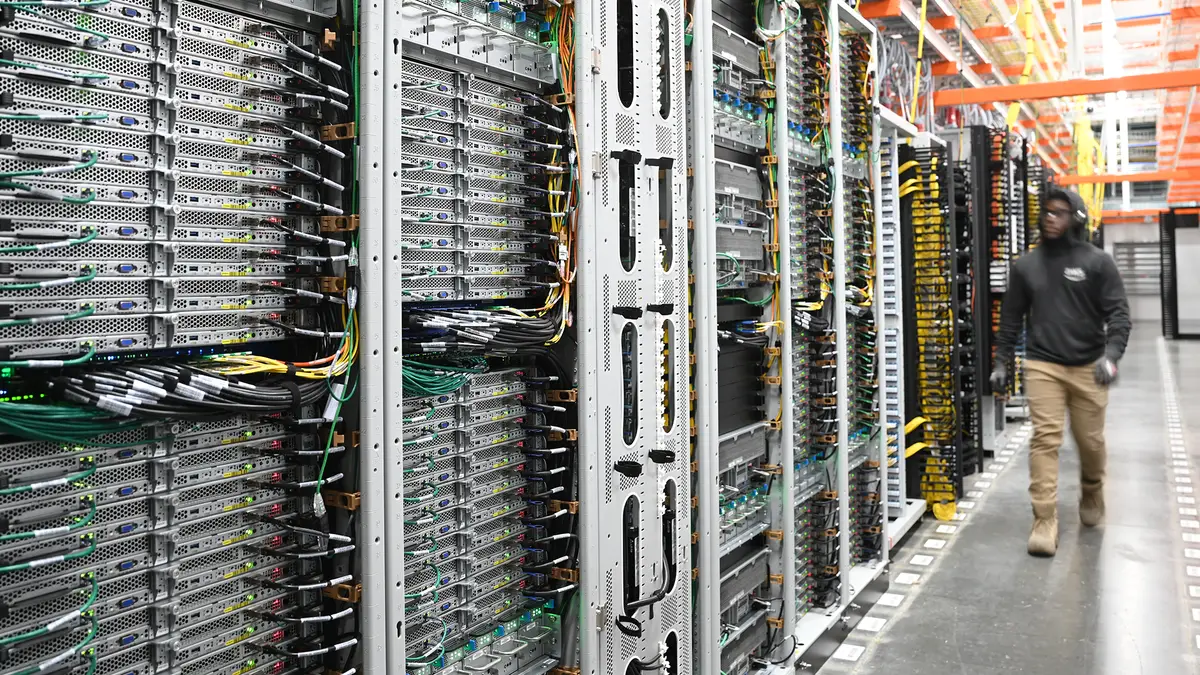
Featured image: Server racks inside an Amazon Web Services data center (a general AWS facility photo, not specific to Bedrock or Kimi), via About Amazon. Source