AWS Pricing Calculator API and Billing Data Hub Explained: Cost, Setup and Limits
AWS Pricing Calculator API prices 500 usage lines per call for free; Data Hub lets FinOps Agent query resource-level costs. Setup, limits, FAQs.
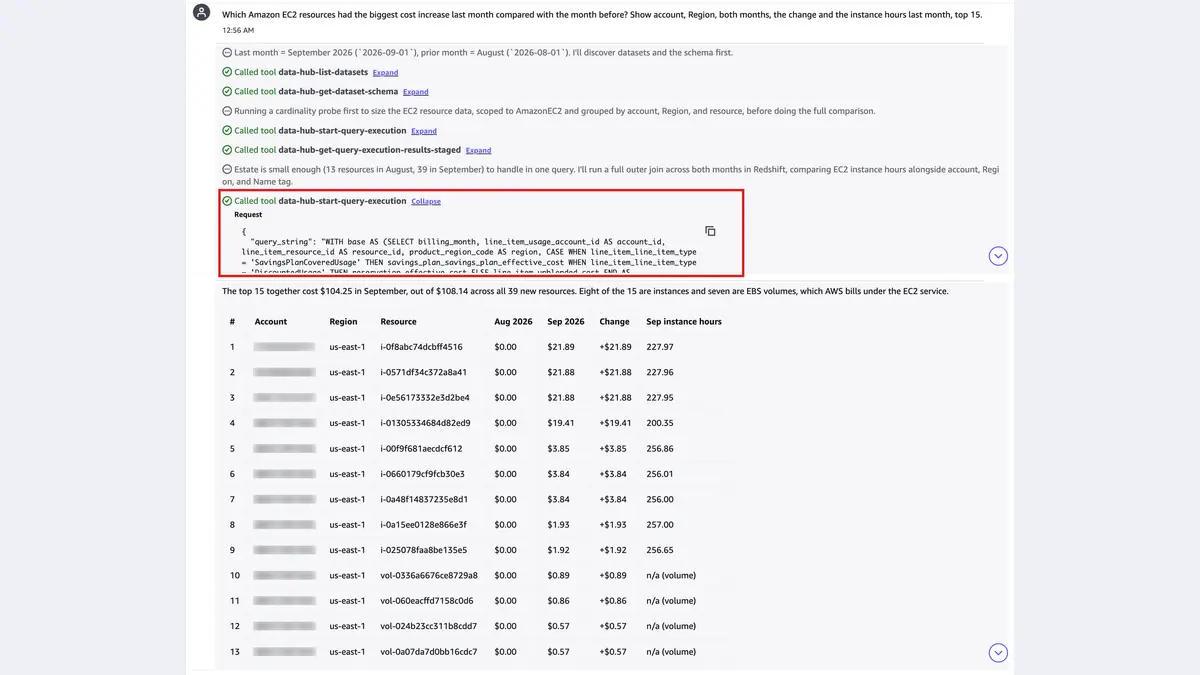
Short answer: On 20 November 2026 AWS made three billing launches. AWS Pricing Calculator now has an API, GetUsageLinesEstimatedCost, that returns the estimated cost of up to 500 usage lines in one call, at no additional charge. Data Hub, in preview, gives the AWS FinOps Agent a managed, SQL-queryable copy of 13 months of your hourly, resource-level cost data, free during the preview. And a new set of payment APIs shows balances, due invoices and payment methods from the SDK or CLI.
In plain terms: you can now price a design in code before you deploy it, ask an AI agent "which resources made last month's bill go up?" without building a data pipeline, and check whether invoices are paid without opening the console. This guide explains each launch, what it costs, how to try it, and where the limits are.
What did AWS announce for billing and cost management?
| Launch | Status | Price | Where |
|---|---|---|---|
Pricing Calculator API (GetUsageLinesEstimatedCost) |
Generally available | No additional charge | All commercial Regions (not GovCloud or China) |
| Data Hub in Billing and Cost Management | Public preview | No charge during preview | Set up in US East (N. Virginia); covers usage in all Regions |
| Payment status APIs (six operations) | Available | Not stated by AWS | US East (N. Virginia) endpoint; for customers in all commercial Regions |
Sources: AWS What's New posts for the Pricing Calculator API, Data Hub and the payment APIs.
What is the AWS Pricing Calculator API?
The AWS Pricing Calculator has long been a web tool. The new GetUsageLinesEstimatedCost operation lets a script, CI pipeline or AI coding agent ask the same question in code: "what would this usage cost?"
According to AWS, you send up to 500 usage lines per request and get back the cost of each line plus a total. Unlike the calculator's saved workload estimates, nothing needs to be saved to your account first. AWS's two suggested uses are checking a design's cost before you deploy it, and letting an AI coding agent "price a workload while helping you design it."
What goes into a request?
According to the AWS CLI reference, each usage line needs five fields:
| Field | What it means | AWS's example |
|---|---|---|
serviceCode |
The service | AmazonEC2 |
usageType |
The billing usage type | BoxUsage:t3.micro |
operation |
The billing operation | RunInstances |
key |
Your own ID (up to 10 letters or digits) to match results | web1 |
amount |
Usage in the usage type's pricing unit (0 or more) | 730 |
You also choose a rate type:
BEFORE_DISCOUNTS: public On-Demand rates.AFTER_DISCOUNTS: your rates after negotiated discounts.AFTER_DISCOUNTS_AND_COMMITMENTS: your discounted rates plus Savings Plans and Reserved Instances.
You can only use a rate type your Pricing Calculator rate preferences allow. If your account uses billing transfer as a bill source account, only BEFORE_DISCOUNTS is allowed.
What does a call look like?
This uses the shorthand syntax documented in the AWS CLI reference, with AWS's own example values:
aws bcm-pricing-calculator get-usage-lines-estimated-cost \
  --rate-type BEFORE_DISCOUNTS \
  --usage serviceCode=AmazonEC2,usageType=BoxUsage:t3.micro,operation=RunInstances,key=web1,amount=730
The response includes totalCost, a currency (USD is the only listed value), a lineItems list with each line's usageAmount, usageUnit (for example Hrs or GB-Mo) and cost, and an errors list. Lines that can't be priced come back in errors with a code (BAD_REQUEST, NOT_FOUND, CONFLICT or INTERNAL_SERVER_ERROR) and aren't counted in the total. Always check errors before you trust totalCost.
AWS notes that estimates don't include taxes and that actual charges depend on actual usage.
Pricing Calculator API vs the AWS Pricing MCP Server: which should I use?
People searching for "AWS pricing calculator MCP" usually mean the open-source AWS Pricing MCP Server, which AWS released in July 2025. The two tools do different jobs:
| Pricing Calculator API (new) | AWS Pricing MCP Server (2025) | |
|---|---|---|
| What it returns | A cost for a usage amount, plus a total | Price list data: rates, products and Region availability |
| Your discounts and Savings Plans | Yes, with the AFTER_DISCOUNTS... rate types |
Public pricing data |
| Best for | "What will this design cost per month?" | "What does an r8g.large cost in Frankfurt?" |
| Format | AWS API, SDK and CLI | MCP server for AI assistants |
The two complement each other: an agent can look up the right usage types with one and total them with the other. AWS hasn't said whether the MCP server will add the new API.
What is AWS Billing and Cost Management Data Hub?
Data Hub is "a managed data layer that enables AWS FinOps Agent to query cost and usage data with SQL." Put simply, AWS keeps a ready-to-query copy of your detailed bill so an AI agent can answer questions about it. Until now, that kind of resource-level analysis usually meant exporting the Cost and Usage Report (CUR 2.0) to S3 and querying it with Athena or a data warehouse.
According to AWS's launch blog and announcement:
- 13 months of hourly, resource-level data: the 12 months loaded at creation plus the current month.
- It uses one schema,
cost_usage, which follows the published CUR 2.0 data dictionary and includes resource IDs and cost allocation tags. - AWS provisions and refreshes the data daily, and maintains the schema as new services and charge types arrive.
- A dataset created from the management account covers member accounts in your AWS Organizations organization, including accounts that join later.
- In preview, only the AWS FinOps Agent can query it. The agent runs read-only SQL and shows the query next to each answer.
The FinOps Agent is itself labelled a preview. AWS's product page doesn't list a price for it.
What can you ask the FinOps Agent with Data Hub?
AWS's blog walks through four types of question:
- "Which resources drove last month's cost increase?" The agent compares effective cost, so usage covered by Savings Plans or Reserved Instances shows at the price you paid.
- "What did each team spend, and which resources have no cost-center tag?" This is a showback report using cost allocation tags.
- "Which IAM principals drove our AI spend?" This uses the
line_item_iam_principalcolumn for Amazon Bedrock inference calls, which is only populated if IAM principal data is turned on. - "How does last month's total break down by invoice and charge type?" The agent checks totals against
ListInvoiceSummaries.
How do I set up Data Hub?
Per AWS's blog, you need an AWS Organizations management account, Billing console access in US East (N. Virginia), IAM permissions to create a dataset and grant the Data Hub read and query actions, and a FinOps Agent to connect. Then:
- Sign in to the Billing and Cost Management console with the management account in us-east-1.
- Open the Data Hub page and choose Create dataset.
- Connect the dataset to your AWS FinOps Agent, then ask questions in plain language.
For AI-spend-by-principal questions, tag the IAM users and roles that call Bedrock and activate those tags as cost allocation tags. AWS warns that a tag can take up to 24 hours to appear for activation, and up to 24 more to apply.
What are the new AWS payment status APIs?
The payment APIs let you check your account balance, find invoices that are due or past due, see which payments and credit memos were applied to each invoice, and confirm your payment methods are active, all through the SDKs and CLI. The six operations are GetFinancialRecord, BatchGetFinancialRecord, ListFinancialRecords, GetAccountBalance, GetPaymentInstrument and ListPaymentInstruments. AWS says you can call them from your own tools "or through an AI agent." The announcement doesn't mention pricing.
This is mainly useful for finance teams that chase AWS invoices by hand, and for MSPs that manage many accounts.
Which new AWS billing tool do I need?
| Your problem | Use | Notes |
|---|---|---|
| "How much will this architecture cost before we build it?" | Pricing Calculator API | Free; up to 500 lines per call |
| "Why did last month's bill jump?" | Data Hub + FinOps Agent | Preview; management account in us-east-1 |
| "Which team or Bedrock app is spending the most?" | Data Hub + cost allocation tags | Needs tags; allow 24–48 hours |
| "Is our invoice paid, and is the card still valid?" | Payment status APIs | SDK or CLI |
| "Stop us from overspending at all" | AWS spend limits | A separate feature; now with SMS alerts |
| "Is my free tier about to run out?" | AWS Free Tier guide | Avoid surprise bills |
What are users saying?
We searched Reddit, the AWS forums and developer press for reaction to these launches and found no substantive public discussion yet. The announcements went out late on Friday, 20 November. AWS's blog quotes three customers that used Data Hub before launch: Sicredi, freee K.K. and Talkdesk. freee's co-founder Ryu Yokoji says the investigation "needed no SQL queries and no Athena environment." These are vendor-selected customer quotes, not independent reviews.
The open questions we expect from readers:
- Will the Pricing Calculator API accept all usage types, or will some services return
NOT_FOUND? - Will the FinOps Agent cost money when it leaves preview?
- Will Data Hub open up to other query tools (Athena, QuickSight, your own agents) after the preview?
Editor's take
The Pricing Calculator API is the most immediately useful of the three: it's free, generally available, and solves a real gap. Pricing infrastructure in code used to mean scraping the price list and doing the maths yourself. With AI coding agents now writing so much infrastructure, a single "what will this cost?" call that respects your discounts is exactly the kind of guardrail teams need. Data Hub is promising, but it's tied to a preview agent, limited to the management account and set up from us-east-1, so treat it as a trial for now. Keep your CUR 2.0 export running until AWS says what Data Hub and the FinOps Agent will cost after the preview. AWS re:Invent starts on 30 November, and cost tooling announcements often cluster around it, so expect more (see our re:Invent 2026 guide).
Also published today: AWS Quick plugins, Flows and guardrails explained.
FAQ
Is there an API for the AWS Pricing Calculator?
Yes. Since 20 November 2026, GetUsageLinesEstimatedCost (CLI: aws bcm-pricing-calculator get-usage-lines-estimated-cost) returns estimated costs for up to 500 usage lines per request.
Is the AWS Pricing Calculator API free?
Yes. AWS says it is generally available "at no additional charge."
Does the Pricing Calculator API include my discounts and Savings Plans?
It can. Choose AFTER_DISCOUNTS or AFTER_DISCOUNTS_AND_COMMITMENTS, if your rate preferences allow them. BEFORE_DISCOUNTS uses public On-Demand rates.
Is the AWS Pricing Calculator API available in GovCloud?
No. AWS says it's available in all Regions except the AWS GovCloud (US) and China Regions.
What is AWS Data Hub?
Data Hub in AWS Billing and Cost Management is a preview feature that keeps 13 months of hourly, resource-level cost and usage data (CUR 2.0 schema) ready for the AWS FinOps Agent to query with SQL.
How much does AWS Data Hub cost?
Nothing during the preview, according to AWS. Pricing after the preview hasn't been announced.
What is the difference between the AWS Pricing Calculator and Cost Explorer?
The Pricing Calculator estimates the cost of usage you plan to run. Cost Explorer, and now Data Hub, analyse what you have already spent.
Can I check if my AWS invoice is paid with the CLI?
Yes. The new payment APIs, such as ListFinancialRecords and GetAccountBalance, show due and past-due invoices, applied payments and your balance through the SDKs and CLI.
Sources
- AWS What's New: AWS Pricing Calculator now estimates workload costs through a new API (20 Nov 2026)
- AWS CLI reference: get-usage-lines-estimated-cost
- AWS What's New: Data Hub in AWS Billing and Cost Management, preview (20 Nov 2026)
- AWS Cloud Financial Management Blog: Ask AWS FinOps Agent resource-level cost questions with Data Hub (20 Nov 2026)
- AWS What's New: Billing and Cost Management APIs to track payment status (20 Nov 2026)
- AWS FinOps Agent (preview) product page
- AWS What's New: MCP Server for AWS Price List (14 Jul 2025)
Featured image: Screenshot of AWS FinOps Agent answering a resource-level cost question with Data Hub, from AWS's launch blog (official AWS product image). Source