Werner Vogels' 5 Tech Predictions for 2027, Explained (and How They Compare to 2026)
Amazon CTO Werner Vogels' 5 tech predictions for 2027 explained: self-defending software, sovereignty, brain-inspired chips, AI cures and brain interfaces.
Amazon CTO Werner Vogels published his annual tech predictions on 24 November 2026, and there are five of them this year. They are: computing that copies the brain, software that constantly attacks itself to stay secure, "sovereignty" as a design requirement, AI agents helping scientists find cures, and brain-computer interfaces that don't need surgery. Below is each prediction in plain English, the evidence Vogels cites, and what it could mean for developers, IT teams and everyone else.
These are one executive's forecasts, not Amazon product announcements. Where Vogels names an AWS service, we point that out.
What are Werner Vogels' tech predictions for 2027?
Here are all five at a glance. The titles are Vogels' own, from his All Things Distributed blog and Amazon's summary on About Amazon.
| # | Prediction | In one line | Timeframe Vogels gives | AWS product he mentions |
|---|---|---|---|---|
| 1 | Computing returns to biology | Chips will copy the brain's habit of storing and processing data in the same place, because energy is the new constraint | Ongoing; no hard date | None |
| 2 | Every system defends itself | Your own AI agents will attack your software before and after release | "In 2027" | AWS Continuum; Amazon's internal Autonomous Threat Analysis |
| 3 | Sovereignty becomes a non-functional requirement | Where data lives, who holds the keys and which AI models touch it must be designed in and provable | Now / 2027 | AWS European Sovereign Cloud, AWS KMS customer-managed keys |
| 4 | Collaboration between scientists and agents leads to new cures | Agents speed up disease research while scientists direct and verify it | A cure "before the decade is out" | None |
| 5 | The mind becomes readable | Brain interfaces move from surgical implants to non-invasive devices | By the end of the decade | None |
1. Computing returns to biology: what does it mean?
Most computers keep memory and processing separate and shuttle data between them, which wastes energy. Amazon's summary puts it this way: "The human brain, by contrast, computes in memory, improves with use, and runs with the efficiency of a small lightbulb."
The concrete examples in Vogels' blog post:
- Cortical Labs (Melbourne) grows living human neurons on silicon. Vogels writes that a CL1 "typically holds about 200,000 neurons" and "runs on 25 to 30 watts". A full rack of 30 CL1s "draws under 1,000 watts, while next-generation GPU racks are expected to draw around 600 kilowatts."
- Neuromorphic chips: he cites a University of Texas at Dallas chip that learns by strengthening connections between neurons that fire together, and a Peking University processor that computes inside memory.
- AI agent memory: he argues agents should rank memories by importance, compress them and prune them, instead of searching their entire history every time.
What it means for you: nothing to buy yet. The practical takeaway is that energy cost per task is becoming a design constraint alongside dollars and latency. That matters to anyone running large AI inference bills.
2. Every system defends itself: what changes for developers?
This is the prediction with the most direct impact on working engineers. Vogels' argument is that finding and exploiting software flaws used to take expertise and weeks of work, which gave defenders time to patch. Cheap AI agents running in parallel have collapsed that window.
The evidence he cites (all from his post):
- In April, Anthropic described pointing "a thousand copies of Claude Mythos Preview" at OpenBSD. It found a 27-year-old flaw in the TCP stack, and "the run that found it cost less than $50."
- Microsoft reported that generating proofs of concept for 182 confirmed Linux kernel crash findings took an average of 21.5 minutes and $3.61 per successful case.
- Mozilla's engineers fixed 423 security bugs across releases in April, "compared with roughly 20 to 30 in a typical month in 2025."
His prediction: in 2027, adversarial testing moves into every phase of development. Before anything ships, your own agents attack copies of your environment, and "those attacks will continue for as long as the system runs." He compares it to Toyota's Andon cord, which lets any worker stop the production line when they spot a defect.
He names AWS Continuum as an early example, a service that finds risks in customer code and proves which ones are exploitable. We explained it in our AWS Continuum pricing and penetration testing guide.
What it means for you: if your security testing is an annual pen test plus a scanner in CI, Vogels thinks that's already too slow. Expect more vendors, AWS included, to pitch continuous, agent-driven testing.
3. What does "sovereignty as a non-functional requirement" mean?
A "non-functional requirement" is something a system must be (secure, fast, cheap), as opposed to something it must do. Vogels says CIOs' top question used to be cost. Now it's how geopolitical tension affects where data is stored, where workloads run and which services they depend on.
His argument:
- Builders should treat data location, key ownership and which AI models touch the data the way they treat security and cost, and make them provable on every deployment. That matters because agents can now copy data or swap models within minutes.
- He cites the default server-side encryption in Amazon S3 and customer-controlled keys in AWS KMS.
- He notes AWS operates 39 Regions and points to the AWS European Sovereign Cloud, which he says has no critical dependencies outside EU borders.
- His warning against overcorrecting: "isolation is not the same thing as control." Decide workload by workload, and rehearse moving between Regions and models.
What it means for you: if you use AI services, find out where inference actually happens. Our explainer on Amazon Bedrock in-country inference by Region covers that for Bedrock.
4. Will AI agents really help find a cure?
Vogels' prediction is that "before the decade is out", scientists working with AI agents will discover a cure for a disease that medicine today can only manage. He's careful about the division of labour: "Scientists will direct the work and verify each result."
The early signs he cites:
- In a late-stage melanoma trial, a personalised mRNA cancer vaccine combined with pembrolizumab reduced the risk of recurrence and distant metastasis compared with pembrolizumab alone. Machine learning picked the vaccine's targets from each patient's tumour mutations.
- A drug whose target and molecule were identified computationally entered Phase III trials for idiopathic pulmonary fibrosis.
- Google DeepMind's AlphaFold has been used by "more than three million researchers across 190+ countries".
He also stresses that therapies still have to prove safety and effectiveness in clinical trials. This is a forecast, not medical news, and nothing here is health advice.
5. "The mind becomes readable": are brain interfaces coming?
Vogels argues the next interface after keyboard, touch and voice will read intent directly from neural signals. To reach everyday use, he says, those interfaces will have to be non-invasive.
The data he cites:
- A 2024 YouGov survey found only one in five people would consider a brain implant, and 11% in the United States.
- This summer, researchers at Meta and several European labs used a magnetoencephalography scanner outside the skull to decode typing, reaching 61% word accuracy on 90 hours of recordings.
- Chinese brain-interface companies raised more than 4.6 billion yuan in six months, which he says is nearly three times all of 2025. Merge Labs raised $252 million to explore ultrasound, and the UK is putting £69 million into new neural-interface research.
His timeline: by the end of the decade, non-invasive interfaces help people who can't speak to communicate, and people who can't move to control devices or prosthetics.
How do the 2027 predictions compare with 2026's?
Amazon published Vogels' 2026 list on 25 November 2025. Putting the two side by side shows how the themes have moved:
| 2026 predictions (Nov 2025) | 2027 predictions (Nov 2026) |
|---|---|
| Companionship is redefined for those who need it most | Computing returns to biology |
| The dawn of the renaissance developer | Every system defends itself |
| Quantum-safe becomes the only safe | Sovereignty becomes a non-functional requirement |
| Defense technology changes the world | Collaboration between scientists and agents leads to new cures |
| Personalized learning meets infinite curiosity | The mind becomes readable |
Our reading: last year's list was about people (companions, developers, students). This year's is more about infrastructure and risk: energy, security and sovereignty make up three of the five. Security carries over in a different form. Last year it was quantum-safe cryptography; this year it's agent-versus-agent testing.
Checklist: what to do about these predictions in 2027
Practical steps for engineering and IT teams. This is our suggestion, not Vogels':
- Inventory your attack surface. You can't continuously attack what you don't know exists. AWS's new API Gateway API Portal is one way to find unmanaged APIs on AWS.
- Add security testing to every stage, not just one yearly pen test. Start with your most exposed, internet-facing services.
- Write down where each workload's data and keys live, and which AI models it calls. Then check that you can prove it from logs or config.
- Rehearse a Region or model switch for one important workload, as Vogels suggests.
- Track energy per AI task, not just cost per token, if you run heavy inference.
Is Werner Vogels still at Amazon?
Yes. He's still Amazon's CTO, and the predictions were published under that title. He did step back from his long-running re:Invent keynote: there's no Vogels keynote at re:Invent 2026. Our re:Invent 2026 keynote schedule explains who has his old Thursday slot.
What are people saying?
We looked for community discussion before publishing but found no substantial thread we could link and quote, so we're not quoting anyone. Based on search suggestions, readers mainly want:
- the full list of Werner Vogels' tech predictions, and the previous years' lists for comparison
- whether these predictions are AWS product roadmaps (mostly no; only a few name AWS services)
- what "sovereignty as a non-functional requirement" means in practice
Editor's take
Read the security prediction as the one aimed at you. The others are long-range bets, such as cures and brain interfaces "by the end of the decade". The figures Vogels cites for prediction #2 (under $50 to find a 27-year-old bug, $3.61 per kernel crash proof) describe things that have already happened. If attackers can run thousands of cheap agents against your code, testing once a year is a losing position. It's also no coincidence that AWS sells products in two of the five areas, security testing and sovereign cloud. That doesn't make the forecasts wrong. It does mean they double as a pitch.
FAQ
What are Werner Vogels' predictions for 2027?
Five predictions: computing returns to biology; every system defends itself; sovereignty becomes a non-functional requirement; collaboration between scientists and agents leads to new cures; and the mind becomes readable.
When were Werner Vogels' 2027 tech predictions published?
On 24 November 2026, on his All Things Distributed blog and on Amazon's About Amazon news site.
What were Werner Vogels' tech predictions for 2026?
Published on 25 November 2025: companionship redefined for those who need it most; the dawn of the renaissance developer; quantum-safe becomes the only safe; defense technology changes the world; and personalized learning meets infinite curiosity.
Who is Werner Vogels?
Amazon's Chief Technology Officer. He publishes his technology predictions every year and writes the All Things Distributed blog.
Is Werner Vogels speaking at re:Invent 2026?
He isn't giving a keynote. AWS's 2026 schedule has no Vogels keynote after he said his December 2025 keynote would be his last.
What is AWS Continuum, mentioned in the predictions?
An AWS service that finds security risks in customer code and proves which are exploitable. Vogels cites it as an early example of systems that "defend themselves".
Are Werner Vogels' predictions AWS product announcements?
No. They're his personal forecasts as CTO. A few mention existing AWS services, such as AWS Continuum and the AWS European Sovereign Cloud, but no new products were announced with them.
Sources
- Werner Vogels, All Things Distributed: Tech predictions for 2027 and beyond
- About Amazon: Amazon CTO Werner Vogels' 5 tech predictions for 2027 and beyond
- About Amazon: Werner Vogels' tech predictions for 2026 and beyond
- Wikimedia Commons: UN AI for Good Summit 2025 – Werner Vogels 03

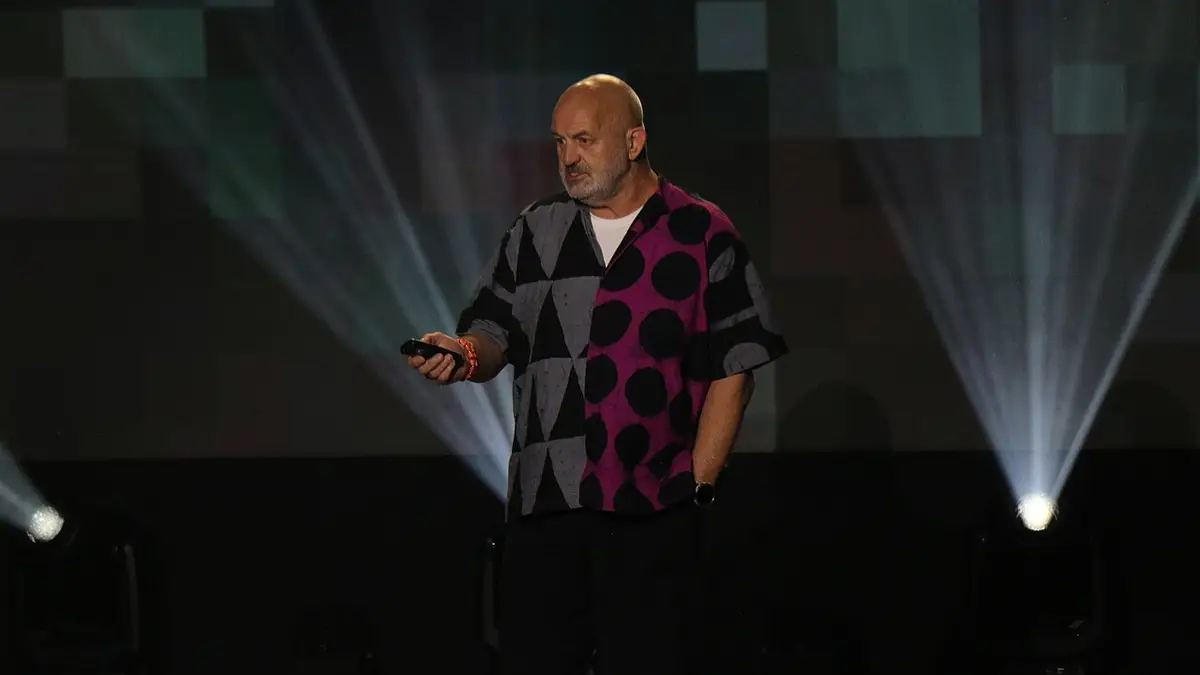
Featured image: Werner Vogels on stage at the UN AI for Good Summit 2025 (July 2025). Photo: Xuthoria, CC BY-SA 4.0, via Wikimedia Commons. Source